How to Get Speakers to Promote Your Conference (With Templates)
Stop hoping speakers will share. Use this step-by-step speaker promotion system, assets, calendar, UTM tracking, and copy-paste templates, to drive real registrations.
Here's the honest version of how most speaker promotion programs work: you send a confirmation email, maybe attach a logo, and then cross your fingers hoping that speaker has a big LinkedIn following and the motivation to use it. Sometimes they post. Usually they don't. And even when they do, you have no idea if it moved the needle.
That's not a speaker problem. That's a system problem.
Speakers are one of your highest-credibility channels. Their audiences are exactly the people who should be at your event. What they're missing is a reason to share, the assets to do it quickly, and a deadline that makes it real. Build those three things and you turn a passive speaker lineup into a measurable event advocacy program that drives real registrations.
Here's how to build it.
Why speaker promotion fails before it starts
Most event marketing leads send speakers a PDF, a stock banner, and a polite ask. The speaker opens it, thinks "I'll do this later," and later never comes.
The friction isn't willingness, it's clarity. Which link should they share? What caption works on LinkedIn vs. WhatsApp? When exactly should they post? Until you answer those questions for them, you're asking speakers to do your marketing job on top of their own.
Gevme's research frames this well: speaker promotion is digital word-of-mouth, and like all word-of-mouth, it scales when you reduce friction and increase specificity. The American Library Association's Promotional Toolkit for Presenters makes the same point in practice, recommending that presenters promote via professional communities and personal networks using ready-made banners for blogs, newsletters, and websites.
The fix is a system, not a request.
Step 1: Give every speaker a unique, trackable share page
Before any asset goes out, make sure each speaker has their own trackable link. A speaker share page should include their bio, session title, date and time, format (in-person or virtual), a clear registration CTA, and properly configured Open Graph metadata so link previews look compelling on LinkedIn and WhatsApp.
If you have the time, add a downloadable "I'm speaking" poster that deep-links to that speaker's specific session. When the asset and the link are session-specific, shares feel personal rather than promotional, and personal shares convert at a meaningfully higher rate.
Step 2: Build a speaker marketing kit they can actually use
A good speaker social media toolkit removes every excuse not to share. At minimum it should contain:
- A personalized "I'm speaking" poster with the speaker's name, headshot, session title, and event date
- A session countdown graphic for the final two weeks
- An avatar card sized for LinkedIn frames or WhatsApp profile pictures
- Copy-paste captions for LinkedIn (professional, value-led, 150-200 words), email (for forwarding to their network), and WhatsApp (short, conversational, includes the link)
The captions matter as much as the visuals. They shouldn't be generic event copy, they should be written from the speaker's perspective, leading with the specific problem their session solves. Give two or three variants per channel so there's no decision fatigue.
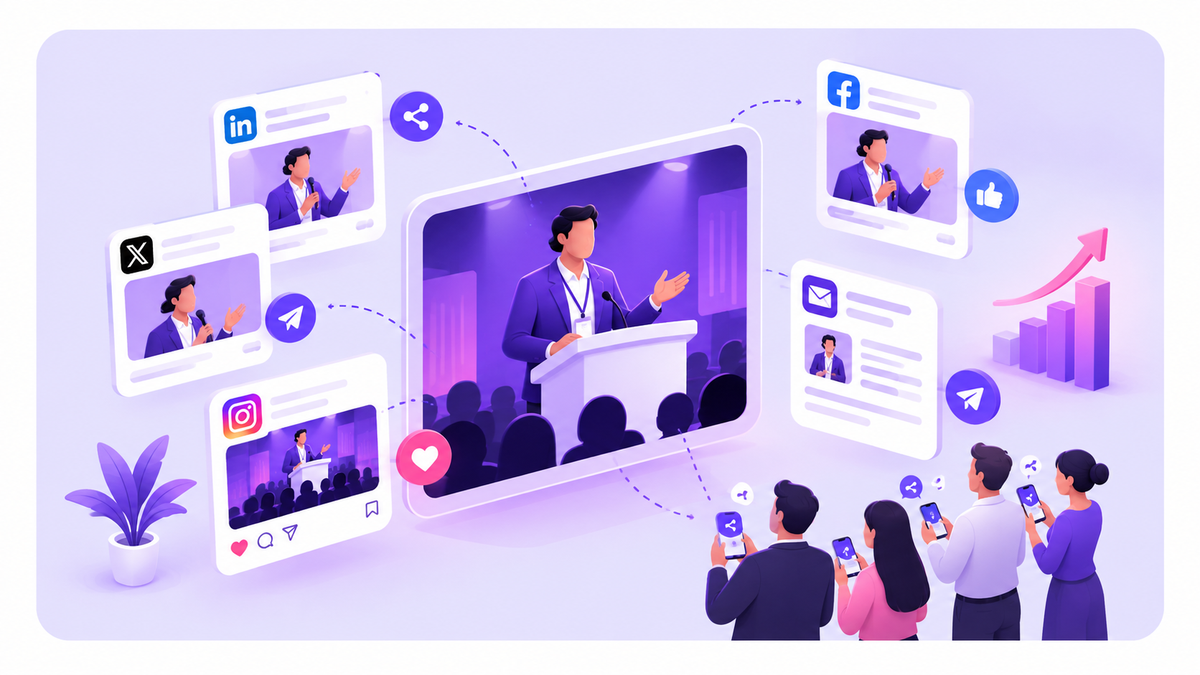
Platforms like Premagic auto-generate personalized speaker-shared posters and avatar cards for every speaker, then trigger multi-channel sharing nudges across LinkedIn, email, and WhatsApp. Speaker-shared posters alone drive up to 40% more session registrations. That's not a paid campaign, that's organic reach from people the audience already trusts.
Step 3: Give them a posting plan, not just a kit
A marketing kit sitting in someone's inbox is just storage. A speaker promotion calendar tied to your registration funnel is a strategy.
Map out four key moments with your speakers:
- Announcement (when the speaker is confirmed): "I'm speaking at [Event]" post
- Early-bird deadline: "Last chance for early pricing" with their unique promo code
- Two weeks out: Session countdown graphic + what attendees will actually learn
- Final 48 hours: Direct registration link with a personal note
For each milestone, tell speakers exactly what to post and where. Give them two variants per channel. And build in an escalation: if a speaker hasn't shared by Day 3 after kit delivery, send a friendly reminder with a fresh asset. This approach of nudging non-sharers until they post keeps the campaign moving without requiring you to manually babysit every speaker relationship.
Step 4: Incentives and visibility, used carefully
Placid.app's guide on conference speaker promotion lists custom coupon codes per speaker as one of six proven tactics. Done right, a unique discount code gives speakers something genuinely useful to share with their audience, and gives you a second layer of attribution on top of your UTM tracking links.
Non-monetary recognition works just as well: feature speakers on your social channels, include them in press releases, or spotlight their session in your email campaigns. Snöball's research reinforces this, speakers respond to being positioned as a marketing partner, not just a content provider.
One note on governance: build a simple brief covering brand tone, disclosure expectations, and any content that shouldn't appear alongside event materials. One paragraph in the speaker agreement handles this cleanly.
Step 5: Track conference speaker referrals end-to-end
This is the step most organizers skip, and it's the one that changes everything about how you'll run your next event.
Set up unique UTM parameters per speaker: utm_source=speaker&utm_medium=linkedin&utm_campaign=[eventname]&utm_content=[speakername]. Pair that with a unique referral link or promo code per speaker. According to airbridge.io's March 2026 analysis of influencer attribution, promo codes and tracking links serve different purposes: promo codes capture shares on closed networks (private Facebook groups, WhatsApp) while UTM links track direct clicks. Use both.
Your KPIs per speaker: clicks, registrations, and conversion rate. Define a 7-to-14-day attribution window, most shares convert within 72 hours, and report results back to speakers after the event. Showing a speaker that their post generated 47 registrations is the most powerful pitch you have for your next conference.
Premagic's advocacy tracking attributes every registration back to the advocate who shared, via unique referral links and promo codes, so you know exactly which speakers delivered the most value, not just who posted the most frequently. At GITEX GLOBAL 2025, that system activated 32,000+ attendees driving measurable referrals and reach across the event lifecycle.
Step 6: Nudge non-sharers, don't rely on hope
Even with great assets and a clear calendar, some speakers won't post after the first ask. That's expected. Build a drip sequence:
- Day 0: Kit delivery with clear instructions and a firm deadline
- Day 3: Reminder if no share detected, with a fresh visual
- Day before early-bird close: "Last chance to share" message with the discount code front and center
- 48 hours before the event: Final push with a session countdown graphic
Each reminder should include a new asset, not the same one repeated. Fresh content gives hesitant speakers a new reason to post, and Premagic's nudge mechanism does exactly this: multi-channel reminders with fresh content continue prompting non-sharers until they post.
Copy-paste templates (use these directly)
Speaker outreach email #1: Kit delivery
Subject: Your speaker promotion kit for [Event Name]
Hi [First Name],
We're thrilled to have you on stage at [Event Name] on [Date]. To make it easy for you to spread the word, we've put together a quick promotion kit, everything you need to share with your network in under 5 minutes.
Included: your personalized "I'm speaking" poster, session countdown graphic, and ready-to-post captions for LinkedIn, email, and WhatsApp.
[Download your kit here] | [Your unique registration link: URL]
Your unique promo code for your audience: [CODE], share this and your followers get [X]% off registration.
Best time to post: before [early-bird deadline]. Questions? Reply to this email.
Speaker outreach email #2: Early-bird reminder
Subject: Early-bird ends [Date], a 2-min reminder
Hi [First Name],
Early-bird pricing for [Event Name] closes on [Date]. If you haven't had a chance to share yet, now's the perfect moment, your network can still lock in the discounted rate.
Use your link: [URL] or your code: [CODE]
Even a quick LinkedIn post goes a long way. We've included a fresh caption below:
"If you're working on [topic area], I'll be speaking at [Event Name] on [Date] about [session topic]. Early-bird pricing ends [Date], grab your spot: [URL]"
Speaker outreach email #3: Last chance
Subject: Last 48 hours, your network can still register
Hi [First Name],
[Event Name] is two days away. If any of your colleagues or followers are still on the fence, this is their last chance to register.
Your link: [URL] | Your code: [CODE]
See you on [Date], we can't wait.
LinkedIn caption template
Excited to be speaking at [Event Name] on [Date].
My session: [Session Title]
I'll be covering [specific problem or insight], something I've been thinking about for [timeframe/context]. If you're in [audience role/industry], this one's for you.
Early-bird registration is still open: [URL]
Who else is going? Drop a comment, would love to connect there.
WhatsApp message template
Hey! Just wanted to share, I'm speaking at [Event Name] on [Date] and thought it might be relevant for you. My session covers [topic in one line]. Here's the link if you want to check it out (early-bird pricing still available): [URL]
Quick FAQ
Do I need to offer discounts for speakers to share? No, but unique promo codes per speaker improve attribution and give speakers something concrete to offer their audience. Non-monetary recognition, social shoutouts, ad features, press inclusion, often drives more sharing than a discount code alone.
How many times should a speaker post? Three to four times across your campaign window (announcement, early-bird, two weeks out, final push) is realistic and non-spammy. Give them fresh assets each time so it doesn't feel like repetition.
Will UTM tracking work if people don't click the link? No, UTMs only fire on clicks. That's why promo codes matter: they capture conversions from shares on WhatsApp groups, private communities, and word-of-mouth that never gets a direct click.
What if speakers share to a private network? Pair unique promo codes with your UTM links. Promo code redemptions surface registrations that your link tracking won't catch.
How do we handle disclosure and brand guidelines? Include a one-paragraph brief in the speaker agreement covering tone, required disclosures (if codes create a commercial relationship), and any content that shouldn't appear alongside event materials. Keep it simple, over-complicated guidelines reduce compliance.
The real unlock: make it measurable
Paid channels will always get you a base of registrations. But the cheapest registration is the one your own speaker generates for free, from an audience that already trusts them.
The reason most speaker promotion strategies fail isn't lack of effort. It's lack of infrastructure: no assets, no timeline, no tracking. Build those three things and you convert your speaker lineup from a passive credential into an active channel with a measurable event marketing ROI.
Premagic is the platform behind GITEX, Informa Connect, and 2,000+ events. It turns speakers, attendees, and sponsors into measurable recruiters, personalized assets, one-click sharing, and attribution that tells you exactly which advocate drove each registration.
Book a demo to see the full speaker promotion system in action, or explore the Event Advocacy Playbook to get started with the framework today.