Paid Ads Aren't Filling Your Event. Run This Channel Instead
Spending more on paid ads but registrations are still slow? The organic channel hiding in your existing audience converts better and costs less.

A conference producer I spoke with recently had a familiar chart on her screen.
Ad spend: up.
Cost per registration: up.
Registrations: flat.
She asked the question every event marketer eventually asks: "We're spending more than ever, why is this getting harder?"
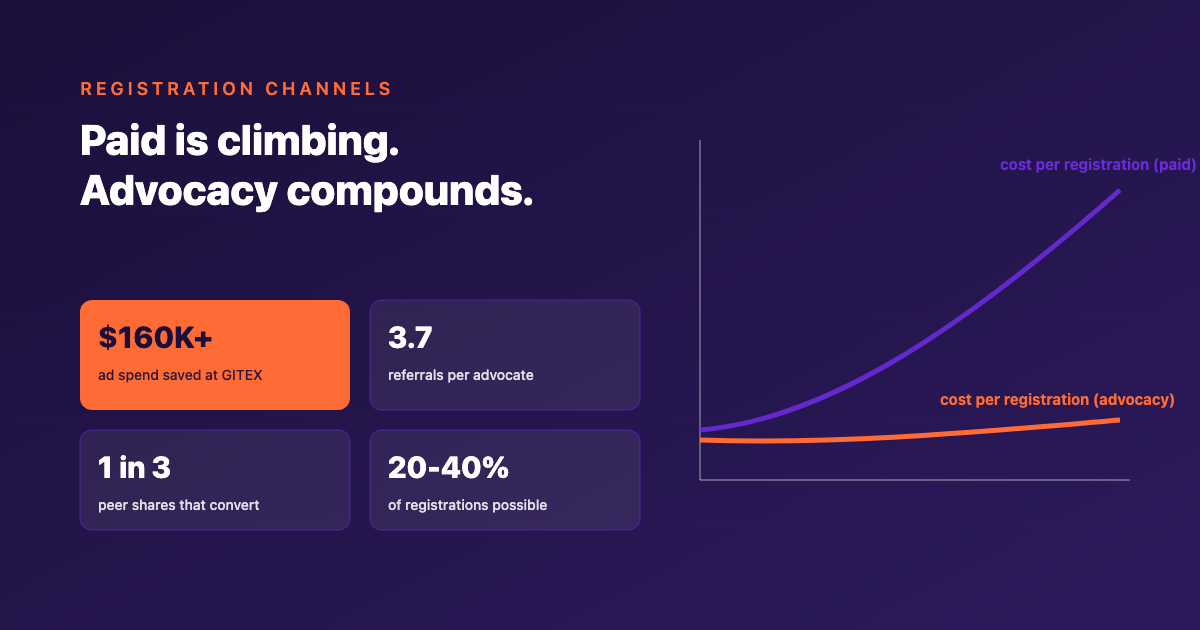
Because paid is a rented audience, and the rent keeps going up. Your ads compete with every other advertiser for the same eyeballs, your targeting hits the same lists everyone else buys, and the moment you stop paying, the channel stops producing.
Meanwhile, the highest-converting channel most events have is sitting unused: the networks of the people already coming.
The math your ad dashboard won't show you
Every confirmed attendee, speaker, sponsor, and exhibitor has a professional network full of exactly the people you're paying to reach. A single "I'm attending" post from a mid-level manager lands in front of hundreds of relevant peers, with something no ad has: personal trust.
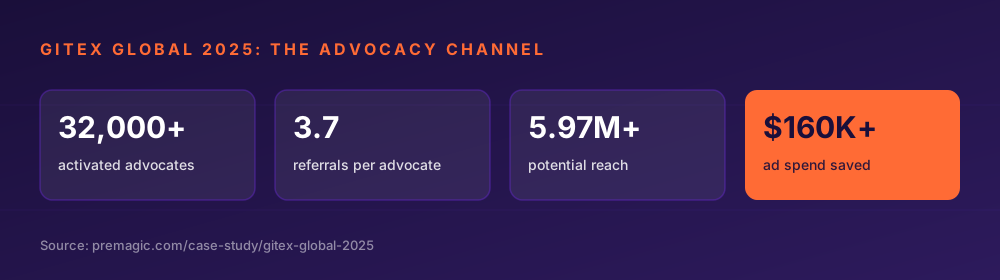
And the numbers compound fast. At GITEX Global 2025, 32,000+ attendees were activated as advocates, averaging 3.7 referrals each, generating 5.97M+ potential reach and saving $160,000+ in ad spend before the event opened.
You don't need GITEX scale for this to work. At the Khaleej Times Future Workforce Summit, roughly 80 attendees posting personalized posters drove 690+ referrals. At G2 Live APAC, 103 advocates produced 796 referrals and the event hit 4x its expected registrations.
Small advocate counts. Outsized results. That's the pattern.
Why organic peers outperform your ads
Industry researchers have been pointing at this for years. CEIR's attendee acquisition research found exhibitor invitation programs among the top registration-conversion tactics, with CEIR's VP of Research calling exhibitors organizers' "lowest collaborative hanging fruit".
The logic extends to every group with skin in the game: speakers promoting their sessions, sponsors announcing their presence, past attendees sharing memories. Each one is a credible messenger with a warm audience.
There's also a budget reality behind this. The CEIR Index shows US exhibition attendance has nearly recovered to 2019 levels, with attendees just 3.7% below pre-pandemic figures, but real revenues remain 15.6% behind. Translation: audiences came back, margins didn't. Channels that grow registrations without growing spend aren't a nice-to-have anymore.
How to actually run the channel (not just hope for it)
"Word of mouth" fails as a strategy because it's passive. An event advocacy campaign makes it active. Four pieces:
1. Personalized assets. Every attendee, speaker, and sponsor gets a branded, personalized "I'm attending" or "I'm speaking" asset the moment they register or confirm. Not a generic banner: their name, their face, their session.
2. One-tap sharing. Pre-filled captions, one-click posting to LinkedIn and other platforms. Every step you remove doubles the number of people who follow through.
3. Unique referral links. Each person's asset carries their own registration link. This is what turns posts into a measurable channel instead of vibes, and it's the foundation for tracking word-of-mouth registrations.
4. A reason to care. Leaderboards, recognition, early access. People share more when they can see what their sharing did.
Platforms like Premagic automate all four: assets generate from your registration data, links are assigned per person, and a live dashboard shows registrations attributed to each advocate.
What to expect, honestly
Advocacy won't replace your whole mix, and anyone who says otherwise is selling too hard. Paid still matters for cold reach. Email still matters for your house list.
But across events running structured advocacy campaigns, peer shares convert to registrations at roughly 1 in 3, and the channel can carry 20 to 40% of total registrations once every audience group is activated. Compare that to what your last retargeting campaign converted at.
The other difference: this channel compounds. Every event builds a bigger pool of past attendees, photos, and proof for the next edition. Paid resets to zero every campaign.
Start with one campaign, this week
Don't boil the ocean. Pick your next event and run a single "I'm attending" poster campaign for confirmed registrants. Measure referrals and attributed registrations. Then expand to speakers and sponsors once you've seen the numbers.
Slow registrations usually aren't a spend problem. They're a channel problem. The audience you already have is the acquisition channel you haven't switched on.
Want to see what an advocacy campaign could add to your registration mix? Reach out to us today.