Alternatives to Paid Ads for Event Promotion: 7 Channels
Seven alternatives to paid ads for event promotion, compared on effort, payoff and metrics, plus rules for picking a mix by event size and goal.
The best alternatives to paid ads are channels you already have access to or can build relationships with.
There are seven: attendee advocacy, email, partnerships, public relations (PR), organic social media, community and creator outreach, and content marketing.
Attendee advocacy can keep bringing in registrations because people share the event with networks that trust them. Paid ads can still help you reach new audiences, but they should not be your only channel.
Here is a familiar situation: the ad budget gets cut halfway through the campaign, and someone asks marketing to find free ways to promote the event. A list gets made, but nobody is responsible for putting it into action. Once again, the team relies mostly on email.
This guide compares the effort each channel takes, what it does well, where it falls short, and how to choose the right mix for your event and its goals. What counts as an alternative to paid ads for event promotion?
An alternative to paid ads is any channel that helps drive registrations without paying for ad placements. It may still cost money, time or tools. The difference is that you invest in content and relationships instead of buying ad space. These channels split into two families:
Owned channels include your email list, past-attendee database, website and content. You control when and how you use them.
Earned channels include attendee shares, media coverage, partner audiences and creator posts. Other people choose whether to share your message.
The main difference is not just the cost. It is who people hear the message from.A banner ad is your organization saying the event is worth attending. A speaker's post is someone their audience already knows recommending it. That personal recommendation can carry more trust than an ad.
The costs can also behave differently. As ad audiences become harder to reach, the cost of each registration may rise. With advocacy, the cost per registration can fall as more people share the event, especially when the campaign assets are reusable.
This matters in 2026 because event attendance and revenue have not recovered at the same pace. CEIR's Q2 2025 Index shows attendee numbers were 3.7% below Q2 2019 levels, while inflation-adjusted revenue was 15.6% lower.
In other words, attendance is close to pre-pandemic levels, but revenue is still lagging. That puts pressure on event budgets.
How do the seven non-paid channels compare?
Each channel has strengths and weaknesses. Choose based on what you need it to do, not just because it seems cheaper than advertising.
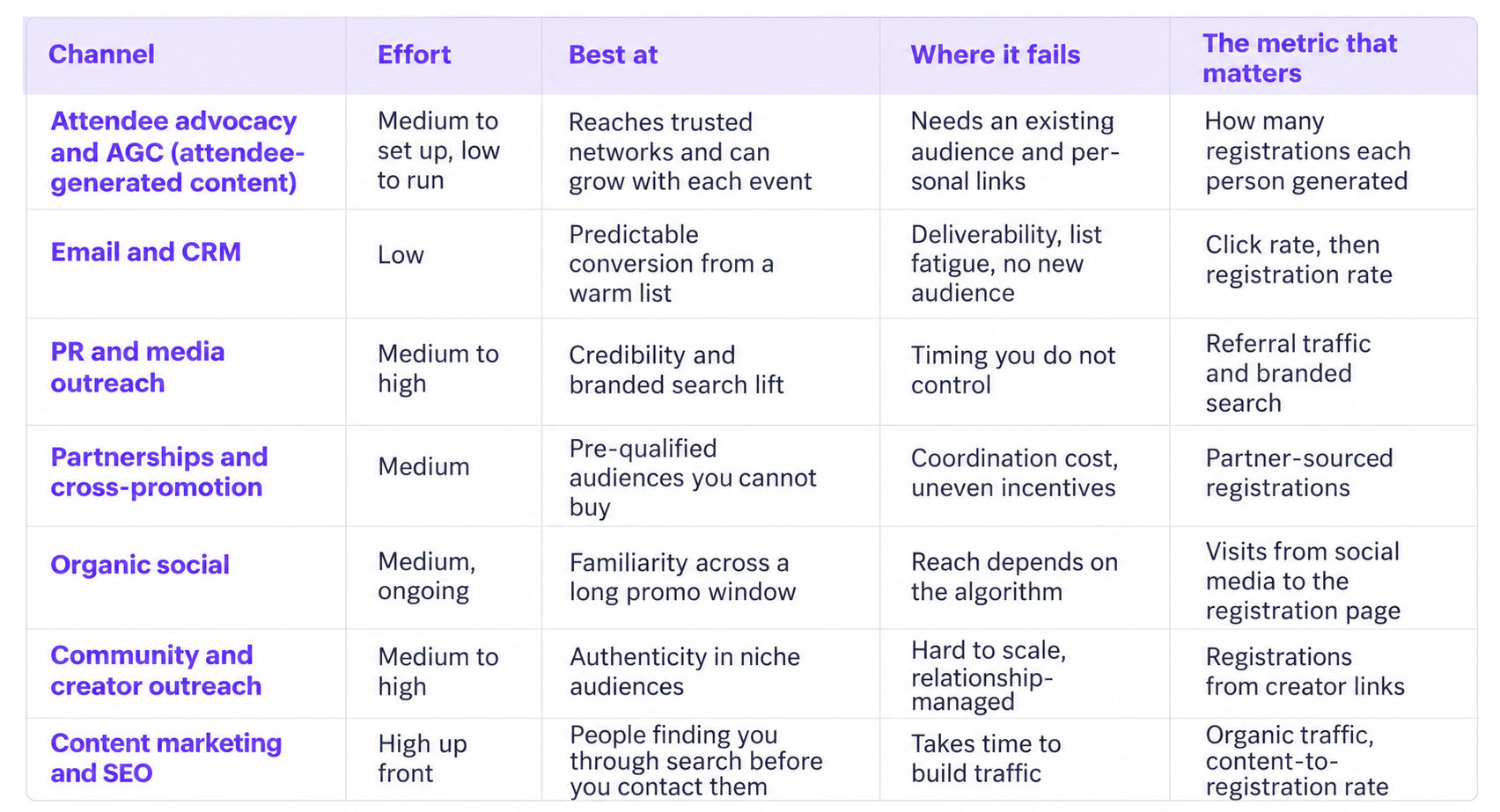
Two patterns stand out from the table.
The quickest channels often have limited reach. Email can bring in registrations quickly, but it only reaches people on your lists. Channels that introduce your event to new audiences usually take longer to work. Attendee advocacy is one channel that can become more cost-effective as more people take part.
Why does participant advocacy outperform the other non-paid channels?
Attendee advocacy is a planned campaign that asks speakers, attendees, exhibitors and sponsors to share personalized content with their networks.
Each person gets a unique referral link, so you can see which registrations came from their shares. Instead of hoping people talk about the event, you give them a clear reason and an easy way to share it.
That tracking matters. Without individual links, it is hard to tell whether the campaign is bringing in registrations.
Advocacy can support all three stages of an event:
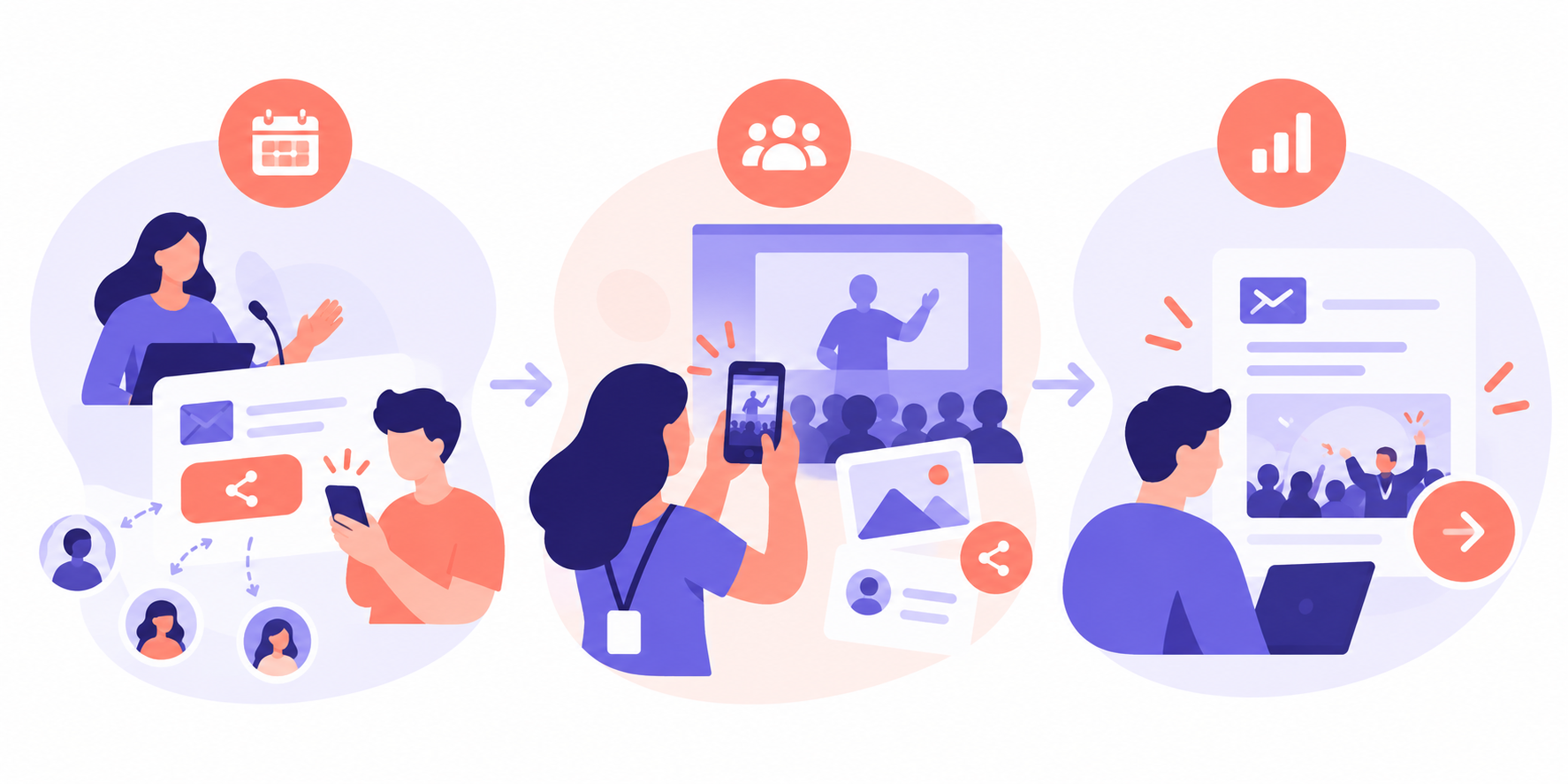
Before the event: Start with speakers, whose audiences are likely to care about the topic. Then invite new registrants to share when they receive their confirmation, while they are excited about attending.
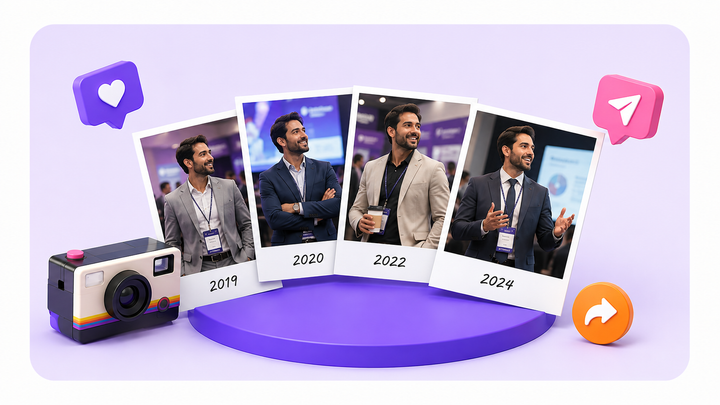
During the event: Give attendees easy-to-share content, such as event photos, AI avatars or session cards for speakers. These moments give people something timely to post.
After the event: Send personalized recaps with a link to the next edition. Photos and highlights can also help promote the next event.
Industry research supports the value of involving exhibitors in promotion. CEIR's attendee-acquisition research identified exhibitor invitation programmes as a useful way to convert prospects into registrants. The research dates to 2023, so treat it as guidance, not a current benchmark.
UFI's 36th Global Exhibition Barometer found that 37% of respondents believe all events need a better format, while another 58% say it depends on the type of event. The two most requested improvements were more opportunities for visitors to participate and more interactive learning formats, each selected by 22% of respondents. Inviting well-known speakers ranked lower, at 7%.
For conversion rates, Premagic's own data is the best source available here. Treat these figures as planning guides, not industry-wide benchmarks: roughly one in three tracked advocate shares leads to a registration, about one in five network invitations converts, and speaker campaigns can increase session registrations by up to 40%.
Two published case studies show what this can look like. At African Tech Summit, 218 attendees promoted the event and generated 600 referral clicks. The advocacy rate reached 50%, compared with a 5% baseline. At GITEX Global 2025, the campaign reported more than $160,000 in ad spend saved before the event opened.
Start by tracking four things:
- How many people shared at least once
- How many clicks each person generated
- How many registrations each person generated
- Cost per registration from advocacy, compared with your cost per registration from ads
The last measure helps you compare advocacy with paid ads. For figures by event type and size, Premagic's event advocacy benchmark draws on data from 366 events.
Where it falls short: advocacy works best when you already have people to involve. A first-time event with no past attendees, confirmed speakers or exhibitors has fewer people to activate. Advocacy also cannot fix a poor event experience. If people did not enjoy the event, they are unlikely to recommend it.
There is also a practical challenge. Creating personalized content, assigning unique links and tracking results for every person quickly becomes too much to manage manually. Advocacy platforms can automate these tasks using registration data.
What do the other six channels actually deliver?
Email and CRM
Your current registrants, past attendees and partner contacts are audiences you can reach directly. Email can introduce the event, encourage registrations and remind people to attend without ad spend. MailerLite's benchmark across 3.6 million campaigns from 181,000 accounts reports a median open rate of 43.46% and a median click rate of 2.09%, covering December 2024 to November 2025. Be careful with open rates. Apple's Mail Privacy Protection can count an email as opened even when a person has not read it, which can inflate the figure. Click rate is usually a more useful measure of engagement.
Where it falls short: email usually reaches people who already know you. Sending the same message to everyone can also lead to more unsubscribes and delivery problems.
PR and media outreach
Press outreach works best when you have real news to share, such as a notable speaker, a new event format or research linked to the event.
Where it falls short: you cannot control when a story is published, or whether it gets covered at all. Use PR to build credibility and help more people search for your event or brand, rather than relying on it for a predictable number of registrations.
Partnerships and cross-promotion
Newsletter swaps, joint webinars and shared community promotions help two relevant organizations reach each other's audiences. For B2B events, this can be effective because the partner's audience may already be interested in the topic.
Give each partner a unique tracking link so you can see how many visits and registrations they generate. This also makes it easier to decide whether to work together again. Our guide on activating exhibitors, sponsors and partners explains how to set this up.
Where it falls short: both sides need time to plan and promote the partnership. If one side feels the arrangement is unfair, the campaign may not get the attention it needs.
Organic socials
Speaker announcements, behind-the-scenes updates and countdown posts help keep the event visible without spending on ads.
Where it falls short: social platforms control how many people see your posts, and that reach can change. Posting regularly is not enough; people need a reason to engage. When appropriate, encourage speakers and team members to post from their own profiles as well as the company page.
Community and creator outreach
Community leaders and creators can attend for free or at a discount, make content with your team and introduce the event to their audiences. Instead of paying for a sponsored post, you offer access and visibility in exchange for genuine participation and content.
Where it falls short: each relationship takes time to build and manage, so it can be difficult to scale. But for specialist conferences and membership organizations, a few trusted voices can be especially valuable.
Content marketing and SEO
Blog posts, research reports and webinars can help people discover your event through search and give them a reason to register before the main promotion period begins.
Where it falls short: content takes time to attract search traffic, so it is not a quick fix for an event that is only days away. Starting 10 to 12 weeks before the event gives you more time to publish and promote useful content. Our 10-week content plan outlines a schedule.
How do you pick a channel mix for your event size and goal?
Start with the size of your event and the time your team has available.Under 300 attendees: Focus on email, attendee advocacy and partnerships. With a smaller audience, you can contact people directly and build relationships without trying to manage every channel.
300 to 2,000 attendees: Focus on attendee advocacy, posts from speakers and PR. Encourage more attendees to share, and use media coverage to introduce the event to people who do not know it yet.
More than 2,000 attendees: You may need all seven channels working together. Keep attendee advocacy connected to email, partnerships, PR and activities at the event. Next, choose channels based on your main goal.
For more help matching channels to different event types, see our channel map. A registration from a speaker, attendee or sponsor can be especially valuable because it comes through someone the new registrant already trusts. And as you improve the campaign and reuse its assets, the cost per registration may fall over time.
Two practical starting points:
Fastest to start this week: email confirmed registrants, give speakers ready-to-share promotional assets, and ask two relevant partners to share your event in their newsletters.
Best to build over the next 90 days: attendee advocacy, content marketing and community outreach. They take time to work, but the content and relationships can continue bringing people in after the initial campaign.
Before choosing your channels, ask five questions:
- Do you have confirmed speakers, sponsors and attendees who can help promote the event?
- Can you track which shares lead to registrations using unique links or codes?
- How much time do you have? If you have 10 weeks or more, content marketing may be worth the effort. If you have fewer than three weeks, focus first on email and attendee advocacy.
- What problem are you trying to solve? Use social media and PR to build awareness, email and advocacy to drive registrations, and reminders to help more registrants attend.
- What could you create or promote with a partner this week?
For more help matching channels to different event types, see our channel map. A registration from a speaker, attendee or sponsor can be especially valuable because it comes through someone the new registrant already trusts. And as you improve the campaign and reuse its assets, the cost per registration may fall over time.
The other channels play different roles. Email reaches people who already know you. PR and partnerships help build credibility. Content marketing can attract people over time.
Attendee advocacy gives people who already know your event a simple way to recommend it to others.
For your next event, start with two channels rather than trying to do everything. Use tracking links for both, then compare their cost per registration with the cost of registrations from paid ads. Use those results to plan next year's budget.
If you want the reasoning behind why paid stops working first, read why paid ads stop filling events. For the week-by-week version of the organic plan, see the organic event promotion playbook. To set up attribution before you start, read how to track word-of-mouth registrations.
Want to see how a tracked attendee advocacy campaign could support your event promotion? Explore Premagic.