
How to track which attendees drive your registrations
Word of mouth drives event registrations you can't see. Here's how referral links, promo codes, and UTMs make every attendee-driven signup visible.

Ask an event marketer where their registrations come from and you'll get a confident channel breakdown: paid, email, partners, direct. Then ask registrants how they heard about the event, and a huge chunk say the same thing: "a colleague told me about it."
That colleague doesn't appear anywhere in the analytics. Their referral got logged as "direct traffic" or credited to whatever retargeting ad happened to fire last.
This is the word-of-mouth measurement gap, and it has a real cost: you can't invest in a channel you can't see. Here's how to make it visible.
Why word of mouth is invisible by default
Standard attribution is built for campaigns you run, not conversations your attendees have. When someone hears about your event over coffee, googles it, and registers, every tool in your stack calls that "organic" or "direct."
The fix isn't a smarter analytics model. It's instrumenting the sharing itself, so the recommendation carries its own tracking.
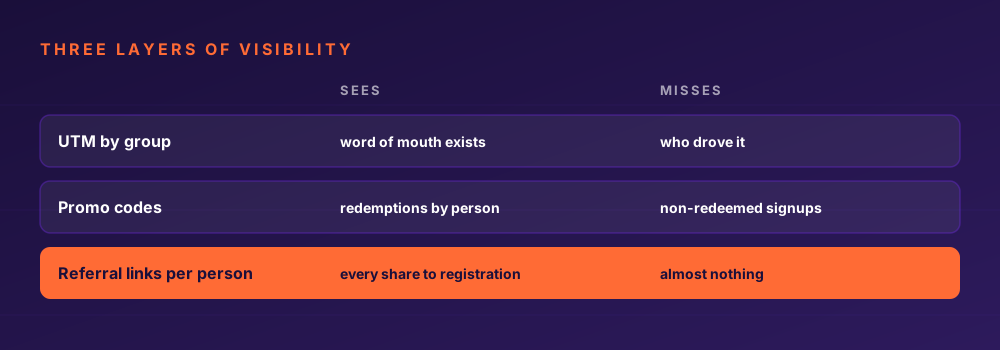
Three layers, from crude to complete:
1. UTM links per audience group
The floor. Give speakers, sponsors, and attendees distinct UTM-tagged links (utm_source=attendee, utm_source=speaker) so shared traffic at least separates from your own campaigns. You'll know word of mouth exists. You won't know who drove it.
2. Promo codes per person
A step better: each advocate gets a code tied to your registration system. Codes survive being pasted into chats and emails, where UTMs often get stripped. The catch: codes only track registrations that redeem them, so they undercount.
3. Unique referral links per person, tracked to completed registration.
The real answer. Every attendee, speaker, and sponsor gets one personal link, embedded in whatever they share: a poster, a photo, an avatar post. Click and registration data flow back per person. Now "word of mouth" stops being a bucket and becomes a leaderboard.
What person-level tracking changes
Once each advocate has their own link, you stop guessing and start managing. You see activation rate (how many participants shared at all), referrals per advocate, and conversions per segment.
The numbers get surprisingly granular. At the IDC Middle East CIO Summit, 212 participants generated 1,074 referral links which drove 1,133 unique clicks, with the program returning an ROI of 7,245%. Not "we think the community helped." Counted clicks, counted registrations, per participant.
Person-level data also tells you where to spend effort next time:
- If speakers convert 5x better than attendees, expand the speaker campaign.
- If 30 advocates drive 80% of referrals, treat them like VIPs (they are).
- If activation is low but per-advocate results are high, your bottleneck is asset delivery and nudges, not the audience.
The same instrumentation keeps paying after the event: once every view and share is tied to a person, your photo gallery becomes a first-party data source too.
And it changes advocate behavior too. When people can see the registrations their shares produced (a leaderboard, a personal stats card), they share again. Measurement isn't just reporting; it's fuel.
Setting it up without a data project
The manual version of this collapses fast past a hundred participants: generating links, mapping them to people, reconciling registrations in a spreadsheet. That's why event advocacy platforms bundle attribution in. Premagic, for example, assigns a unique referral link to every personalized asset it generates, and its dashboard reports clicks, top promoters, and attributed registrations live, no spreadsheet reconciliation.
Whatever tooling you choose, three requirements are non-negotiable:
- Track to completed registration, not clicks. Clicks flatter the numbers. Registrations pay the bills.
- Automate link assignment. If humans generate links, coverage will be partial and the data biased.
- Report per segment and per person. Aggregate word-of-mouth numbers are trivia; person-level numbers are decisions.
Close the loop
One habit turns this data into a durable channel: report it back. Post-event, show your top advocates what they drove, and show your leadership word of mouth as a proper channel line next to paid and email, with cost per registration attached (hint: it wins). Pair the registration numbers with your event's earned media value and the channel shows brand value alongside conversions. If sponsors are in the program, the same counted numbers feed a sponsor report that survives the finance team.
The channel was always there. Instrument it, and it finally shows up in the meeting where budgets get set.
Want to see per-person referral attribution running on a live event? Check out Premagic →