How to Calculate Your Event's Earned Media Value (EMV)
Your attendees' posts have a dollar value: what you'd have paid ads to reach the same people. Here's how to calculate event EMV, step by step.

Earned media value (EMV) estimates what your event's organic reach would have cost if you had paid for the same exposure through advertising. For events, it can help put a dollar value on attendee posts, social shares, photos, and other organic content.
The basic formula is simple:
EMV = (Organic impressions ÷ 1,000) × comparable paid CPM
The harder part is choosing realistic inputs. This guide explains how to calculate event EMV, what numbers to use, how to avoid overstating your results, and how to combine EMV with attributed registrations to get a more complete picture of event marketing ROI.
What is earned media value?
Earned media value is an estimate of the advertising value of exposure your brand receives without directly paying for that exposure. For events, that exposure can come from attendees sharing photos, speakers posting about their sessions, exhibitors sharing their event experiences, or attendees publishing personalized advocacy posts.
Instead of simply reporting: “Our event generated strong social buzz.”
You can use EMV to estimate what that organic exposure would have cost if you had bought it as paid advertising. That makes the number easier to understand in a marketing or budget conversation.
How do you calculate earned media value?
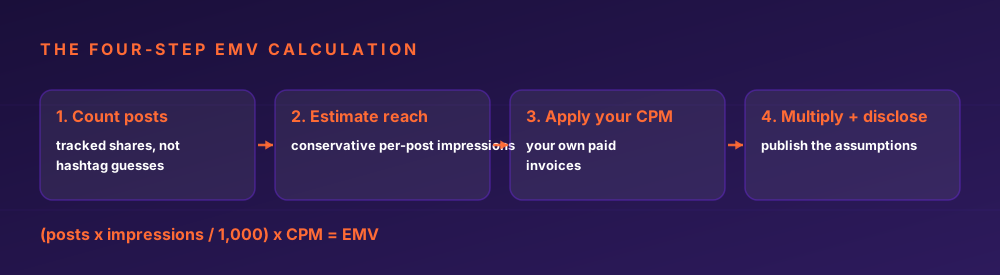
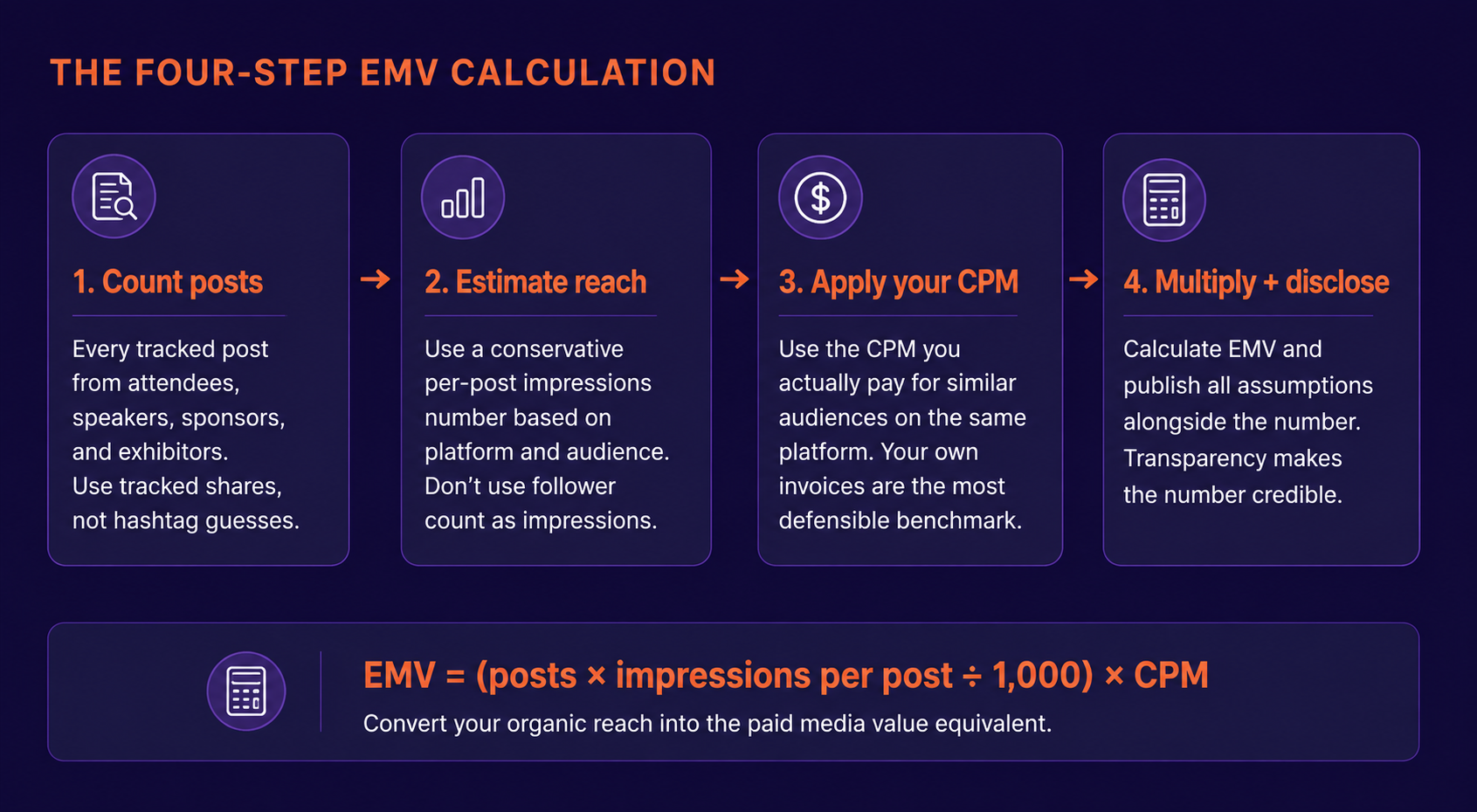
The four-step EMV calculation with the formula
The basic EMV formula is:
EMV = (Organic impressions ÷ 1,000) × CPM
CPM means cost per thousand impressions. For example, if your event-generated content receives 900,000 organic impressions and your comparable paid advertising CPM is $30:
(900,000 ÷ 1,000) × $30 = $27,000 EMV
In other words, you estimate that buying the same 900,000 impressions through paid advertising would have cost approximately $27,000. For an event, there are four steps to getting there.
Step 1: Count your event-related posts
Start by counting the content connected to your event.
This could include:
- Attendee advocacy posts
- Speaker posts
- Sponsor and exhibitor posts
- Shared event posters
- Event photo shares
- AI avatar posts
- Event recap posts
- Other attendee-generated content
The more accurately you can track this activity, the more useful your EMV calculation becomes. A tracked advocacy campaign is particularly useful because you have a record of the shares generated through the campaign instead of relying entirely on a hashtag search.
Step 2: Work out your impressions
Next, you need to determine how many people saw the content. Actual impressions are the strongest input when they are available. If you don't have actual impression data, you may need to use a reasonable estimate based on your platform and audience.
One important rule: don't treat follower count as impressions.
Someone with 5,000 followers does not automatically generate 5,000 impressions from every post. If you have to estimate, be conservative. A smaller number that you can explain is much more useful than a large number that nobody can defend.
Step 3: Use a realistic CPM
Your next input is the cost per thousand impressions for comparable paid advertising. If your team already runs paid campaigns on the same platform, your own CPM data is usually the best place to start.
For example, if you are calculating the value of organic LinkedIn posts from an event, use a CPM that reflects what your organization would realistically pay to reach a similar audience on LinkedIn.
Avoid choosing a high CPM simply because it produces a more impressive EMV. Your calculation is only as credible as the assumptions behind it.
Step 4: Calculate and document the result
Once you have your impressions and CPM, use the formula:
EMV = (impressions ÷ 1,000) × CPM
For example:
1,800 posts × 500 estimated impressions per post = 900,000 impressions
Then:
(900,000 ÷ 1,000) × $30 CPM = $27,000 EMV
Always show the assumptions alongside the final number. That makes the calculation easier for your marketing, finance, and sponsorship teams to understand and challenge if necessary.
If you want to calculate your event's EMV without building the spreadsheet yourself, Premagic has a free Event EMV Calculator that estimates the dollar value of organic event reach, impressions, and shares.
What does event EMV look like in practice?
Real event data makes the calculation easier to understand.
At the IFEAT Annual Conference, more than 4,000 photos were automatically delivered to attendees. The event generated 2,939 social shares, with Premagic reporting an ROI of $17,905 based on average earned media value from organic social shares and estimated impressions.
At GITEX Global 2025, the advocacy program generated 18,166 direct posts and 4,560 indirect posts, for a combined 22,726 posts. The campaign reached a potential 5.97M+ people and was estimated to save more than $160,000 in advertising spend.
These examples demonstrate two ways event teams can communicate the value of organic advocacy: as earned media value or as advertising spend saved. The right approach depends on how your organization reports marketing performance.
Is EMV the same as event ROI?
No. This distinction is important.
EMV measures the estimated value of organic exposure. It does not tell you how much revenue your event generated.
For example, if attendees generate $50,000 in EMV, that does not mean the event made $50,000. Instead, EMV tells you what that organic exposure might have cost if you had purchased it as advertising. For a stronger measurement framework, pair EMV with a performance metric such as attributed registrations.
Pair EMV with attributed registrations
EMV tells you the value of the attention. Attribution tells you what that attention did. With unique referral links that track which attendees drive registrations, you can see which advocates generated clicks and registrations.
That gives you two useful numbers:
EMV: What would the organic exposure have cost as paid media?
Attributed registrations: How many registrations did that advocacy actually generate?
Together, they tell a much stronger story. Instead of saying:
“Our attendees created a lot of social buzz.”
You can say:
“Attendee advocacy generated $27,000 in estimated earned media value and drove 412 tracked registrations.”
The first number shows the value of the reach. The second shows the action that followed. This is also useful when reporting event results to sponsors. A sponsor report built for the finance team can use both exposure and measurable outcomes to show where sponsorship value came from.
What are the limitations of earned media value?
EMV is useful, but it should not be treated as a perfect measure of marketing ROI.
An organic impression is not necessarily worth exactly the same as a paid impression. A post from a trusted colleague may influence someone differently from a paid advertisement, but that additional trust is difficult to capture in a simple EMV calculation. There is also a risk of overstating EMV if you use inflated impression estimates or unrealistic CPMs.
The best approach is to:
- Use actual impressions whenever possible.
- Use conservative estimates when actual data is unavailable.
- Use your own paid media CPM where possible.
- State your assumptions clearly.
- Keep the methodology consistent from event to event.
- Pair EMV with registrations, clicks, or other measurable outcomes.
The goal isn't to make the number look bigger, but to make it defensible.
Make event EMV a recurring metric
Don't calculate EMV once and forget about it. Use the same methodology across your events and track how the numbers change over time.
Useful comparisons include:
- EMV per event
- EMV per activated advocate
- Organic reach compared with paid media spend
- Registrations generated through advocacy
- Cost per attributed registration
- EMV from one event edition compared with the previous edition
This gives you a clearer picture of whether your event advocacy strategy is becoming more effective. As your attendee network grows and more people share content, your event can generate an increasing amount of organic reach without relying entirely on paid promotion.
That is where event advocacy marketing becomes particularly valuable. Your attendees already have the networks you want to reach. The opportunity is to give them something worth sharing and make the resulting activity measurable.
Frequently asked questions about event EMV
What does EMV stand for?
EMV stands for earned media value. It estimates the advertising cost equivalent of organic exposure generated through unpaid channels such as social shares, mentions, and attendee-generated content.
What is the EMV formula?
The basic formula is: EMV = (organic impressions ÷ 1,000) × comparable paid CPM
How do you calculate EMV for an event?
Count the organic impressions generated by your event content, divide them by 1,000, and multiply the result by a comparable paid advertising CPM. For the most useful event measurement, also track the posts, advocates, and registrations that generated those impressions.
Is EMV the same as ROI?
No. EMV estimates the value of organic media exposure. ROI measures the return generated from an investment. EMV can be one part of an event ROI framework, but it should not be treated as revenue.
What should I use for CPM when calculating event EMV?
Use your own paid media CPM for the same platform and a similar audience whenever possible. If that data is unavailable, use a reasonable external benchmark and clearly state the source and assumption.
How can I calculate my event's EMV?
You can calculate it manually using the EMV formula above, or use Premagic's free Event EMV Calculator to estimate the value of your event's organic reach.
The bottom line
“Strong social buzz” is difficult to put into a budget report. Earned media value gives that organic attention a number.
Just remember that the number is an estimate, not revenue. Use realistic assumptions, show your working, and pair EMV with actual outcomes such as attributed registrations. That turns event advocacy from something that sounds valuable into something you can actually measure.
Want to track earned media value and attributed registrations from your event advocacy in one place? Check out Premagic →