How to give sponsors proof your event actually drove results
Sponsors stopped trusting logo placement and footfall guesses. Here's the proof they actually renew on, and how to turn them into promoters too.

The renewal call is where sponsorship stories go to die. The sponsor's marketing lead is on the line, and behind her sits a finance team that reviews digital ad reports every week: impressions, clicks, conversions, cost per lead. Then your event report arrives with a logo on a banner, an estimated footfall number, and a photo of a busy booth.
She can't defend that spend. So she trims it.
This is the real sponsorship problem in 2026. Not attracting sponsors, keeping them. And the fix is to give them the same class of evidence their digital channels produce.
Why the old proof stopped working
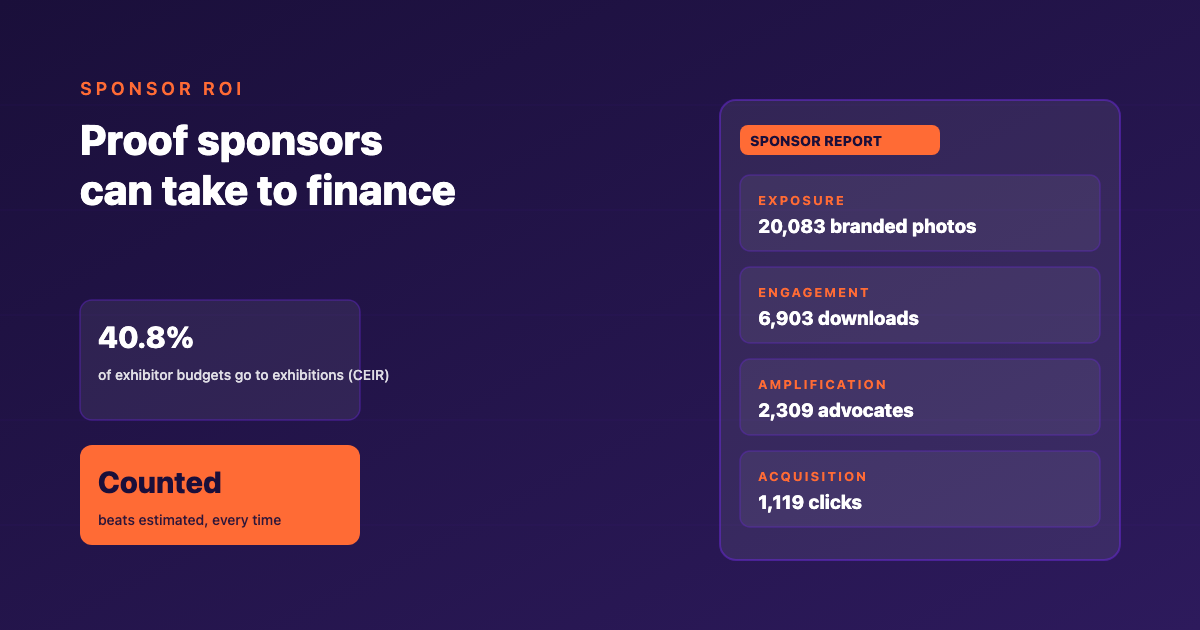
Sponsors are spending serious money on live events. CEIR's 2026 Marketing Spend Decision Report puts exhibitions at 40.8% of exhibitor marketing budgets, the largest single line item, with lead generation, brand awareness, and relationship building among the top outcomes they exhibit for.
Money that big gets finance scrutiny. And "your logo was visible to approximately 5,000 people" doesn't survive it, because nobody can check it, compare it, or connect it to pipeline.
What survives scrutiny is countable, attributable exposure: this many people saw the brand, this many clicked, this many took an action. Events can produce exactly that. Most organizers just don't instrument for it.
The proof that gets renewals: countable, attributable moments
Here's the shift: stop selling sponsors placement and start selling them measurable moments inside the attendee experience.
The clearest example is the event photo gallery. Attendees come back to galleries again and again to find, download, and share their photos. Put a sponsor's brand inside that loop (watermarks on photos, native placements between galleries, a clickable video) and every interaction becomes a logged data point.
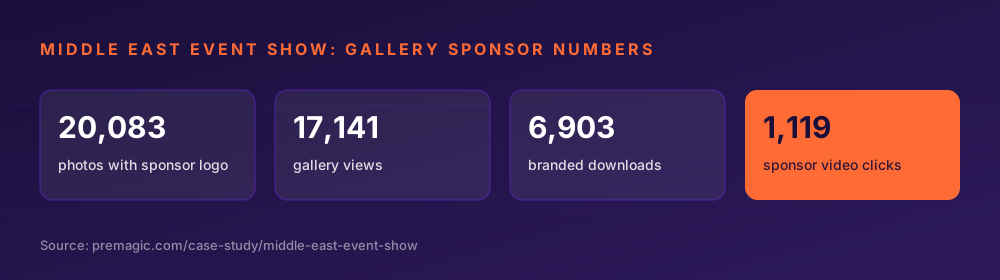
At the Middle East Event Show 2025, the "AI Event Gallery Sponsor" got 20,083 photos watermarked with their logo, 17,141 gallery views, 6,903 branded photo downloads, and a sponsor video that drove 3,506 impressions and 1,119 clicks. The sponsor's own words: it wasn't just logo placement, it was measurable, and it kept working after the event ended.
That's a report a finance team accepts. Views, downloads, clicks, per asset, with timestamps.
The upgrade: sponsors as a marketing channel, not just a logo
Proof is the defensive play. The offensive play is better: make sponsors and exhibitors active promoters of your event, and attribute the registrations they drive.
Think about what a sponsor actually wants from your event: qualified audience, brand association, pipeline. Now think about what they have: an audience of their own. Every sponsor and exhibitor has customers, prospects, and followers who are exactly your target registrants.
CEIR's attendee acquisition research found exhibitor invitation programs among the top registration-conversion tactics, calling exhibitors organizers' "lowest collaborative hanging fruit". Yet most organizers send exhibitors a logo pack and hope.
The structured version works like an event advocacy campaign:
- Personalized assets. Each sponsor and exhibitor gets branded "we're exhibiting" and "meet us at booth X" creatives, generated from their profile, not a generic template they'll never customize.
- Unique referral links and promo codes. Each company (and each individual rep, if you want granularity) gets their own registration link. Shares become trackable acquisitions.
- A leaderboard. Exhibitors are competitive by nature. Show them who's driving the most registrations.
- A closing report. After the event, each sponsor sees what their promotion drove: clicks, registrations, plus their in-event exposure numbers.
Now the renewal conversation inverts. You're not defending their spend; you're showing them the registrations they generated and the audience data they earned. Platforms like Premagic run both halves: the in-gallery sponsor analytics and the referral-tracked promotion campaigns.
What to put in the sponsor report
Keep it to one page per sponsor. Four blocks:
- Exposure: branded photo impressions, gallery views, video impressions. Real counts, not estimates.
- Engagement: clicks on sponsor content, branded photo downloads, CTA actions.
- Amplification: posts and shares carrying the sponsor's brand, with reach, which you can express as earned media value.
- Acquisition: registrations attributed to the sponsor's own promotion (their referral link and promo code).
Add year-on-year comparison from the second edition onward. Growth curves sell renewals better than any single number.
Start before you sell
One practical warning: you can't retrofit attribution. If the watermarks, referral links, and tracking aren't set up before the event, the renewal report can't exist after it. Decide what you'll measure at the same time you price the sponsorship tier.
Sponsors don't leave because events don't work. They leave because nobody proved it worked. Instrument the experience, hand them the numbers, and let them promote their way into your registration report.
Want to see what sponsor-facing analytics look like on a real event? Get in touch with us today.