91% of Exhibition Companies Use AI. So Where’s the Revenue?
AI adoption in events is near-universal, but only 13% of companies use it to generate revenue. Here's where the money actually is.
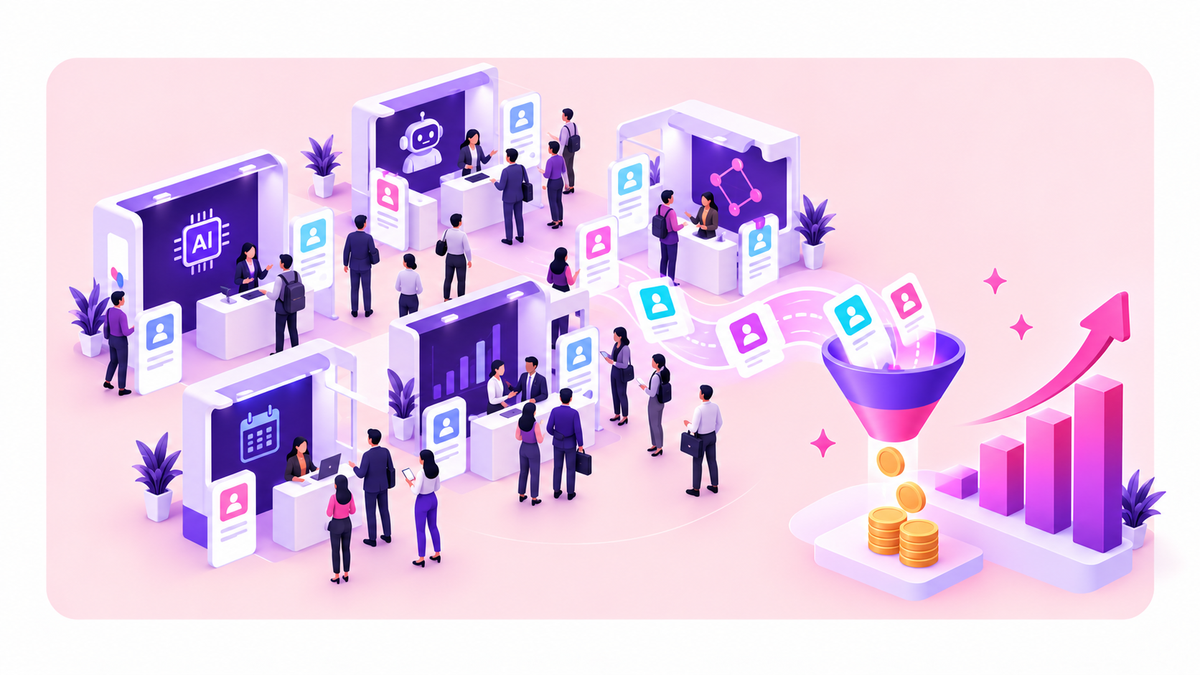
AI is everywhere in events. But is it actually making money?
Ask an event organizer if their company uses AI and the answer is probably yes.
Now ask a different question: what is that AI actually doing for the business? UFI's survey found that most companies are still exploring AI across three areas: improving operational efficiency, improving customer experience, and generating revenue.
Most of that AI is still being used for everyday efficiency. And while 57% of companies are researching or testing AI-powered products for revenue generation, many are still figuring out what that actually looks like in practice.
So the state of AI in events in 2026 is pretty simple: AI is no longer the question. What you do with it is.
And for event organizers, one of the biggest opportunities is connecting AI to something that matters to the business: revenue.
Why efficiency was the easy place to start
There is nothing wrong with using AI to write an email, summarize a meeting or create a first draft of a session description.
In fact, those are exactly the kinds of jobs where AI makes life easier.
UFI's research shows that 68% of exhibition companies use standard AI tools in at least some business functions. Another 15% have AI integrated into existing systems, while 4% have developed their own algorithms using internal data.
For many event teams, this is where AI adoption started: give the team a tool, make a few tasks faster and move on.
The problem is that everyone has access to those same tools.
If your competitor can create an email in 30 seconds instead of five minutes, that is useful. But it is not necessarily a competitive advantage.
The more interesting question is: Can AI change what happens to your event commercially?
That means moving AI out of the back office and into the attendee experience.
Where AI can actually create event revenue
The four patterns where AI can generate event revenue
When you strip away the AI demos and buzzwords, a few practical use cases stand out.
1. Personalization at scale
Imagine you have 5,000 registered attendees.
You could ask your marketing team to create a personalized social post for every single one of them. You could also accept that nobody is going to do that manually.
AI changes the equation.
Personalized “I'm attending” and “I'm speaking” posters can be generated automatically for each participant. The attendee gets something that is about them, rather than another generic event advertisement.
That matters because people are much more likely to share content that represents their own identity, interests or plans.
With the right tracking in place, those shares can also become a registration channel. Each participant can have their own referral link, allowing organizers to see which attendees are actually driving new registrations.
That's the difference between AI making marketing easier and AI becoming part of your event advocacy marketing strategy.
2. Turning event photos into a marketing channel
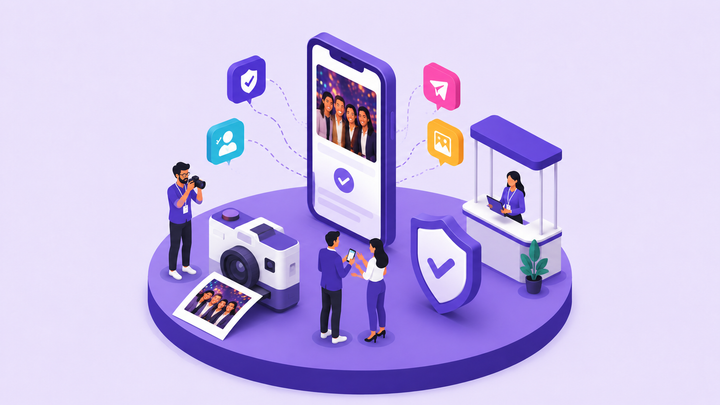
The same principle works during the event. A large conference can produce tens of thousands of photos. The traditional approach is to upload them after the event and send everyone a gallery link.
The problem? By then, the event is over and the moment has passed. AI-powered photo distribution can identify attendees in photos and deliver their personal images while the event is still happening. That gives people something they actually want to share while the event is still fresh.
Our event photo distribution and social sharing guide covers this in more detail. There is real-world evidence behind the idea.
At GITEX Global 2024, Premagic delivered more than 16,000 high-definition photos. More than 7,000 were downloaded and shared on social media, generating 500+ organic posts. The case study reports a projected ROI of $50K+ from that engagement.
The important part isn't simply that AI found people's photos. It turned something the event was already producing into content that attendees could distribute through their own networks.
3. Make AI experiences people actually want to share
This is where things get a little more fun.
AI avatars are a good example because they give attendees a reason to participate voluntarily.
Instead of asking someone to share another branded event graphic, you give them something they genuinely want to see: a personalized version of themselves.
At AI Everything MEA Egypt, the avatar campaign generated 5,013 personalized AI avatars from 3,569 attendees, more than 1,800 LinkedIn posts in one week, and 2,000+ registrations driven through tracked referral links.
That's a very different proposition from using AI to write an email faster.
The AI is part of the attendee experience, the attendee creates something personal, the attendee shares it, and the event can track what happens next.
That's where the commercial value starts to become interesting.
4. Attribution: the part that makes everything else measurable
This might be the least exciting part of AI. It is also one of the most important. If someone shares an avatar, poster or event photo, can you tell whether that share generated a click?
Can you see whether that click became a registration? Can you identify which attendee, speaker or exhibitor drove it?
Without that layer, you have engagement. With it, you have a marketing channel. That distinction matters when you're sitting in front of your CMO, CFO or sponsor explaining where the event's growth actually came from.
So how do you move from AI experiments to AI revenue?
You don't need to start with a giant AI transformation project. In fact, that is probably the wrong way to approach it. Start with one use case that sits close to revenue.
1. Pick one thing to test
For an event, that could be an advocacy campaign designed to generate registrations or AI-powered photo distribution designed to increase organic reach.
If you're evaluating the wider event technology landscape, our event marketing tools buyer's guide is a useful place to start.
2. Decide what success means before you launch
Don't wait until the event is over to figure out what you want to measure. Set up referral links, attribution and reporting from the beginning.
Ask: Are we trying to generate registrations? Increase organic reach? Create sponsor visibility? Increase content sharing? Pick the number that matters.
3. Report it like a marketing channel
Don't put the results under a vague heading like “AI engagement.” Put them alongside your other channels.
Paid media: X registrations
Email: X registrations
Organic search: X registrations
Attendee advocacy: X registrations
Now leadership can compare the channels. That's when the conversation changes.
4. Build on what works
If one AI-powered campaign produces measurable results, run it again. Then add another use case.
The goal isn't to use AI everywhere. It's to find the places where AI makes something possible that would have been too expensive, too slow or too difficult to do manually.
The real AI opportunity for events
The UFI numbers tell us something important.AI adoption isn't really the story anymore. At 87%, the industry has clearly moved beyond asking whether it should use AI. The next question is much more interesting:
Can AI help events make money, not just save time?
That could mean more registrations through attendee advocacy. More organic reach through personalized content. More sponsor value through branded attendee experiences. Or better attribution that finally shows which parts of an event are actually driving growth.
The technology is already here. The opportunity now is figuring out where it belongs in the business model. And that starts with one simple question:
What could AI do at your next event that would directly affect the number on your revenue report?
Want to see what that looks like in practice? Explore Premagic.