How to get speakers to promote your conference on LinkedIn
Your speakers have huge LinkedIn networks but never post about your event. Read on to discover the system that fixes it.
You've confirmed your keynote lineup. The speakers are excellent. Their combined LinkedIn following runs into the hundreds of thousands. And yet, when your conference opens registration, almost none of them post a single thing.
Sound familiar? You're not alone. Getting speakers to promote on LinkedIn is one of the most under-solved problems in event marketing, and the gap between the potential and the reality is enormous.
The good news: this isn't a motivation problem. It's a systems problem. Fix the system, and the posts follow. Speaker campaigns are also the highest-authority arm of event advocacy marketing, so the system pays off across your whole event.
Why most speakers go quiet (it's not what you think)
Speakers are busy professionals with their own content calendars, brand risks, and PR gatekeepers. When you send a generic flyer and a last-minute "please share this" email, you're asking them to do creative work they weren't hired for. They don't know what angle to take, what copy to write, or whether a promotional post fits their personal brand.
The real job is removing friction: pre-written copy, ready-made visuals, a clear angle. Not hoping for organic enthusiasm. Speakers need a story, not a flyer. A reason to post that serves their audience, not just your registration counter.
And the goal here isn't more posts for the sake of reach. The goal is registrations driven by speaker networks. That's a completely different brief, and it requires a completely different approach.
The 3 inputs speakers need before they'll post
If you strip everything back, speakers need three things to feel comfortable promoting on LinkedIn.
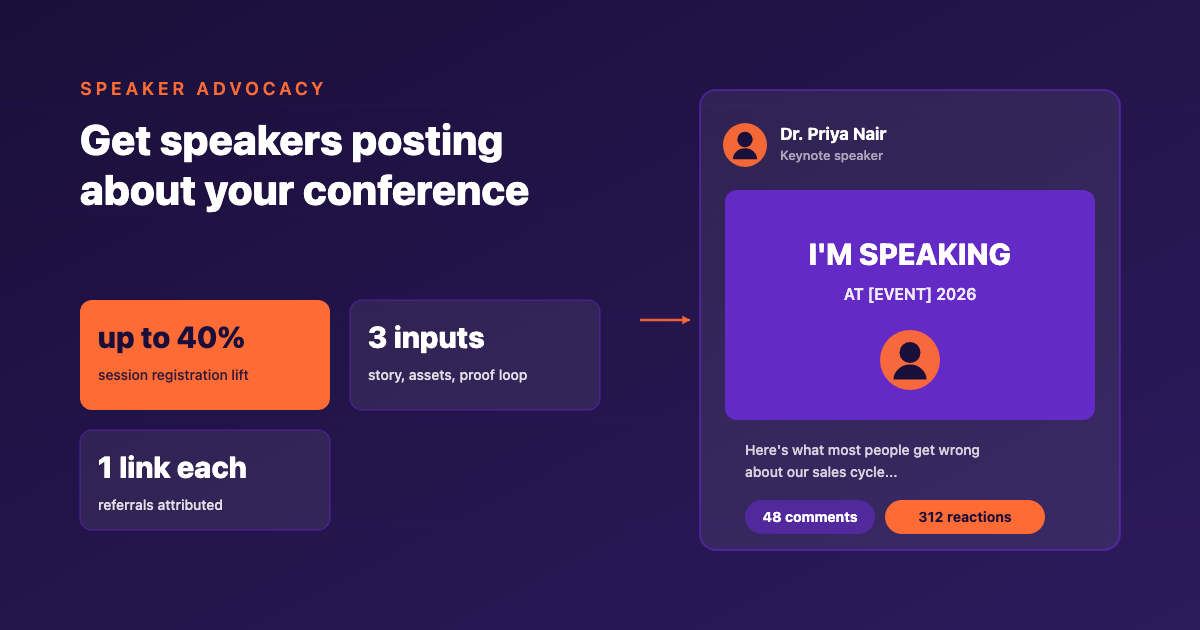
A story angle. Not "come to my event," but a clear line from audience pain to the insight they'll share to the outcome attendees will walk away with. Give them this in two sentences and they can build a post in five minutes.
One-click ready assets. A personalized "I'm speaking at..." poster, an AI avatar card, and a short copy block they can paste directly into LinkedIn. When sharing is one click rather than a creative project, the share rate climbs dramatically. This is exactly the kind of speaker enablement infrastructure Premagic's advocacy campaigns are built around: auto-generated, branded, personalized for each speaker, ready to post.
A proof loop. Unique referral links or promo codes per speaker so they can see what their promotion actually drove. Speakers who see results will post again. Without that feedback, you're hoping for altruism.
How to brief speakers so their posts feel like thought leadership
The speaker brief is the single highest-leverage document you'll produce. Keep it short. Three sentences: the problem their audience faces, the insight from their session, and the promise for attendees.
Then give them a verbatim quote they can lift straight into a LinkedIn post. Something like: "I'm going to share the framework my team used to cut our sales cycle by 40% at [Event Name] on [Date]. Here's what most people get wrong about this..."
Tell them exactly what to mention: the session theme, who it's for, and a single CTA ("register free at [link]"). The posts that fail are the ones with vague claims, self-centered announcements, and link drops with no context. Give speakers the words and you remove the reason not to post.
Build a pre/during/post posting plan (with an asset for each)
One post request is almost always ignored or forgotten. A structured cadence across the full event arc changes that.
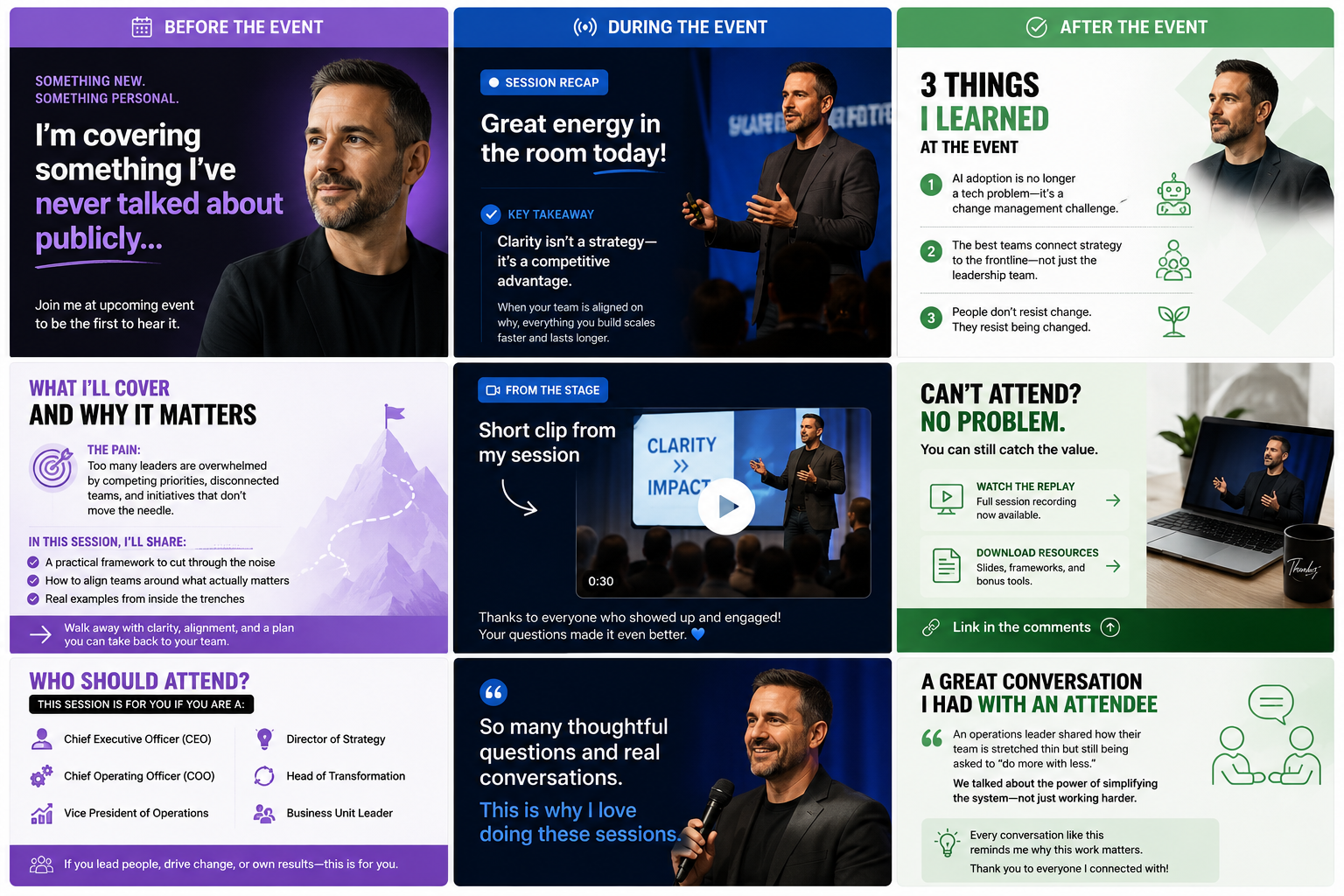
Before the event: A teaser post ("I'm covering something I've never talked about publicly..."), a "what I'll cover" post mapped to a specific audience pain, and a "who should attend" post that names the exact job titles that will benefit most.
During the event: A quick session recap with one takeaway, plus a photo or short video clip. Visual posts routinely outperform plain text on LinkedIn, and a speaker on stage is the most shareable photo there is.
After the event: A "3 things I learned" post, an invitation to watch the replay or download resources, and a reflection on a conversation they had with an attendee. These post-event pieces often get the highest engagement because the content is proven and the speaker is still energized.
Map every post to a specific asset so the speaker isn't reinventing content from scratch each time. At the Khaleej Times Future Workforce Summit, around 80 attendees sharing personalized "I'm Attending" posters drove 690+ referrals. The same logic applies to speaker-specific assets, with the added weight of a speaker's authority behind each post.
LinkedIn-native tactics that extend reach
The format matters almost as much as the content. Structure every post as a hook line, two to four bullets, and a clear CTA. Keep the hook to one sentence that stops the scroll.
Hashtags: use 3 to 5 relevant ones per post. For a B2B tech event, that might be the event hashtag, the industry vertical, and one broad tag like #B2BMarketing. Don't stuff 15 tags hoping for algorithmic lift, it reads as spam.
Tagging: tag your organization's LinkedIn page to extend reach, but keep it to one or two tags per post. Over-tagging dilutes the professional tone speakers have worked to build.
Engagement timing is where most organizers leave reach on the table. Comment on the speaker's post within the first hour. Have two or three team members lined up to engage the moment a speaker posts. Early engagement signals to LinkedIn's algorithm that the content is worth amplifying. Build a Slack channel or simple spreadsheet where your team can drop the live post link for immediate pile-on.
YOU MAY ALSO LIKE: 7 ways to repurpose conference content to get year-round ROI
The speaker enablement kit: exactly what to send
Here's a practical checklist for what goes in the kit you send speakers at confirmation (we've also published a full speaker enablement kit with copy-paste templates):
- Outreach email template (three sentences: what you're asking, why their network will care, and what you're providing)
- Three LinkedIn post templates (teaser, "I'm speaking," post-event recap), each with [FILL IN] blocks clearly marked
- One-paragraph comment template your team can use when they post (to seed early engagement)
- Asset pack: personalized speaker poster, AI avatar card, event countdown image, and a unique registration link with UTM parameters
The UTM-tagged link is non-negotiable. Without it, you're flying blind on which speaker drove which registrations. Structure your UTMs simply: utm_source=speaker&utm_medium=linkedin&utm_campaign=[eventname]&utm_content=[speakername].
For teams running large conferences, an advocacy platform automates the asset generation and unique link assignment, so you're not building 40 custom design files manually.
An 8-week speaker promotion calendar
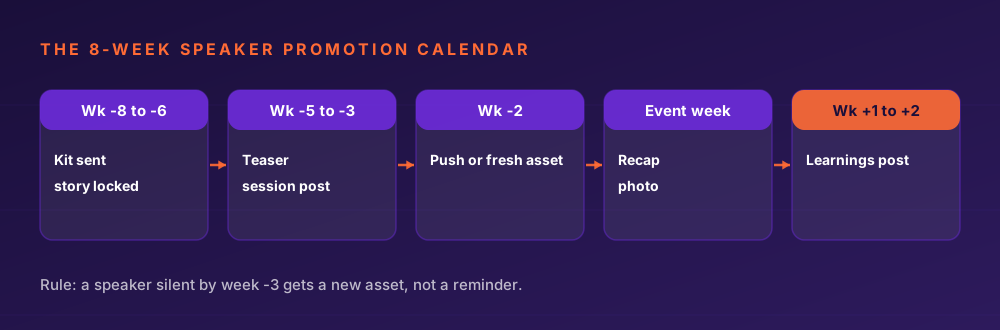
Here's the schedule that works:
- Weeks -8 to -6: Confirm participation, lock in the story angle, send the enablement kit with all assets and templates.
- Weeks -5 to -3: First teaser post goes live. Follow up with the "what I'll cover" post. Your team comments within the hour.
- Week -2: Registration push post. If the speaker hasn't posted yet, trigger a micro-nudge: a new asset (try the countdown image) with a two-line message: "This one works really well on LinkedIn right now, your unique link is [X]."
- Event week: Session recap post + photo. Have a photographer or team member send the speaker a photo within two hours of their session.
- Weeks +1 to +2: Post-event learnings post, replay/resource invite, or a reflection on audience Q&A.
Contingency rule: if a speaker hasn't posted by the start of Week -3, don't send another generic reminder. Send a new asset. Novelty beats persistence.
YOU MAY ALSO LIKE: Best Event Marketing Tools in 2026: A Practical Buyer's Guide
How to measure what actually worked
Attribution starts at the unique link level. Every speaker gets their own UTM-tagged registration URL and, where possible, a promo code tied to your registration system. This lets you see not just clicks but completed registrations by speaker.
Track four KPIs: post engagement (likes + comments + shares), link click-through rate, registration conversions from each speaker's link, and assisted conversions (where the speaker's post was the first touch but not the last).
After the event, send each speaker a one-page "performance snapshot": how many people saw their posts, how many clicked, and how many registered. This closes the loop and makes the conversation about next year's partnership easy. Speakers who see real numbers want to repeat the experience. Those who get silence don't post again.
For a sense of what this looks like at scale, GITEX Global 2025 activated 32,000+ advocates across speakers, attendees, and exhibitors, averaging 3.7 referrals per advocate. All of it built on exactly this kind of asset-plus-attribution infrastructure. And speaker campaigns specifically can amplify session registrations by up to 40%.
The four mistakes worth avoiding
- Sending a share request with no copy or assets. Fix: brief + templates + one-click visuals.
- Making a one-time ask. Fix: a pre/during/post cadence with fresh assets at each stage.
- No tracking. Fix: unique UTM links and promo codes per speaker from day one.
- Waiting for the algorithm to do the work. Fix: your team engages within the first hour, every time.
Turn your next keynote into a LinkedIn recruiting engine
The speakers you've already confirmed are sitting on audiences your paid campaigns can't reach as cheaply or as credibly. The blocker isn't their willingness. It's the absence of a system that makes sharing feel natural, fast, and worth doing.
Build the brief. Send the kit. Run the calendar. Track the registrations. Then show speakers what they drove.
Your cheapest registration is the one a speaker generates for free. The system above is how you start capturing it.
Want to see how personalized speaker campaigns and referral attribution work in practice? Talk to us!